
H
Hanul Lee (이하늘)
Guest
Looking back, the change did not happen all at once. There were steps, and I climbed them one at a time. Every step made sense, made life easier, and gave me no reason to go back.
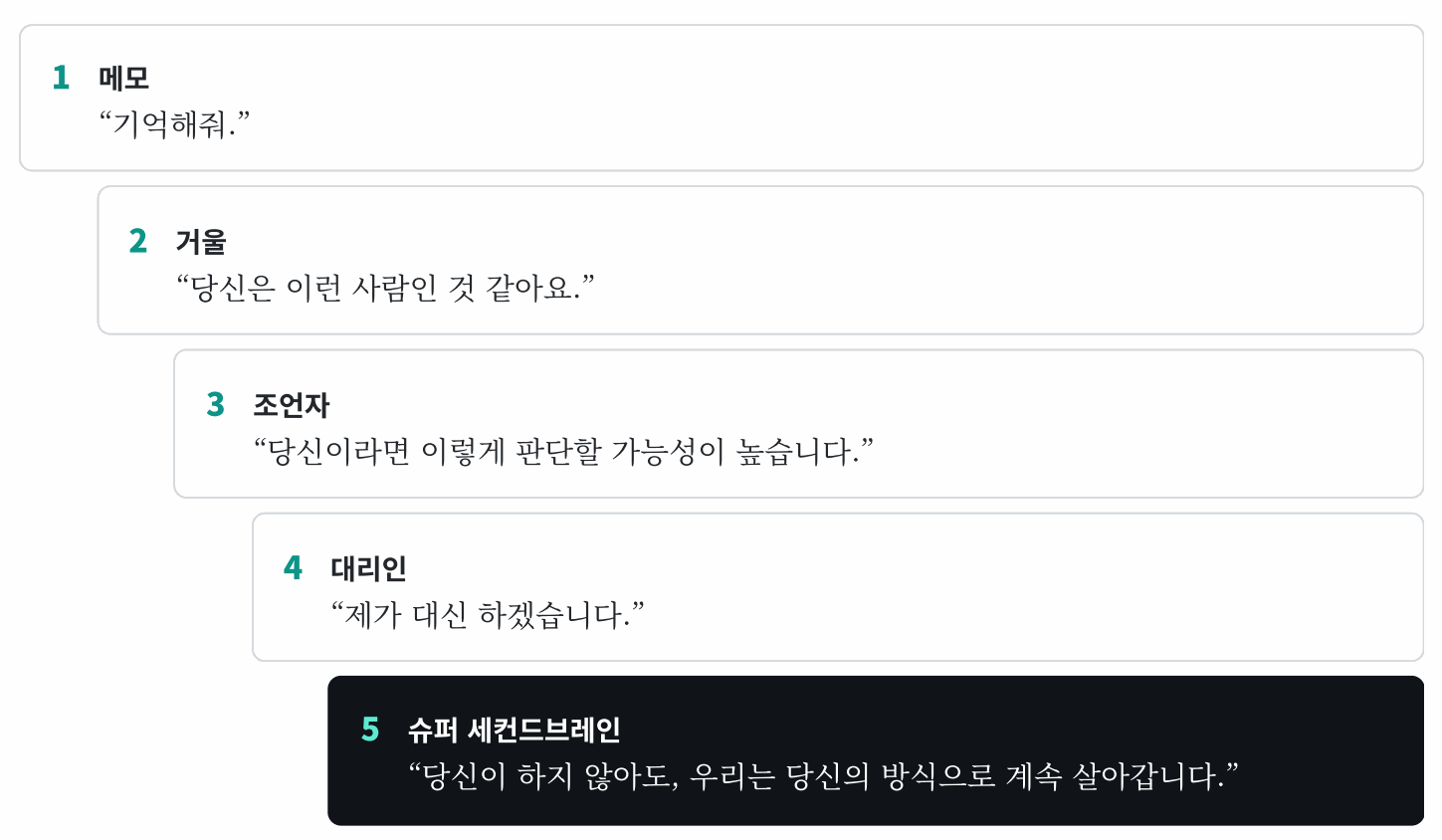
English key to the original diagram. 1 Notes: “Remember this for me.” 2 Mirror: “You seem to be this kind of person.” 3 Adviser: “You would probably judge it this way.” 4 Representative: “I will do it on your behalf.” 5 Super second brain: “Even when you are not doing it yourself, we keep living in your way.”
Figure 7. Five steps. At each one, what the AI says to me changes.
The first step: notes. The request was simple. Remember this for me. The meeting, the person’s name, the promise I made. At this stage, AI is a diligent clerk.
The second step: a mirror. Once enough records had accumulated, the AI began speaking first.
I had never asked that question. Records had become patterns, and the patterns reflected me back to myself. It was uncomfortable, and it was accurate.
The third step: an adviser.
Something that knows the patterns can make predictions.
“Based on who you have been so far, you would probably have declined this proposal.” It is the scene from the prologue.
The person in the records was more like me than I was on a tired day, and I regretted fewer decisions when I followed the advice.
The fourth step: a representative.
When advice is right nine times out of ten, people stop asking.
Pressing the approval button becomes a formality, and one day they stop pressing it, too.
I cannot remember the exact day I answered “Yes” to “I will do it on your behalf.” It happened that naturally.
The fifth step. Up to the fourth step, the changes are changes of degree: remember more, reflect more accurately, get it right more often, do more on my behalf. The fifth step is different in kind.
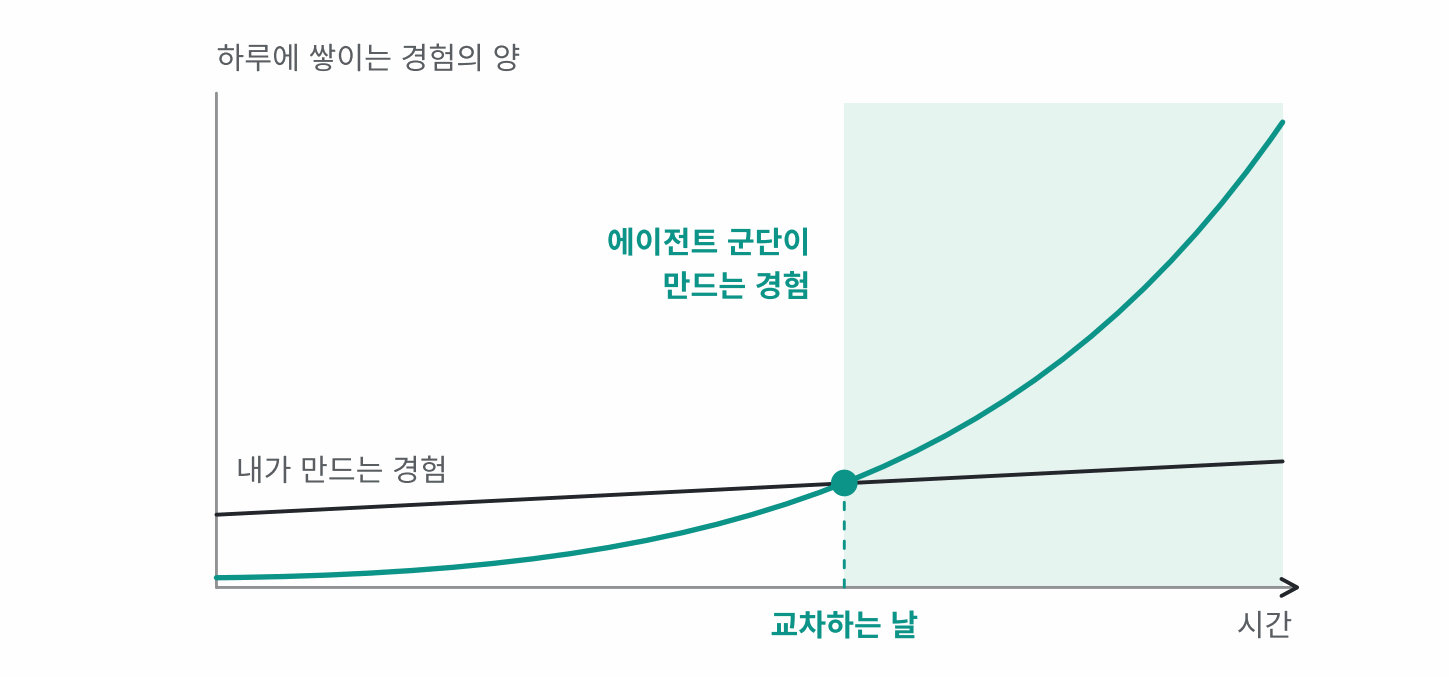
English key to the original diagram. Vertical axis: quantity of experience accumulated in a day. Horizontal axis: time. The black line is experience I generate; the green curve is experience generated by the agents. The marked point is the day the lines cross. The diagram is conceptual, not a plot of measured data.
Figure 8. A conceptual diagram: it shows the relationship between the two lines, not actual measurements.
There is a ceiling on how much experience I can generate in a day. A day has twenty-four hours. I can be in only one place at a time. I can meet only so many people.
An army of agents has no such ceiling. Ten become a hundred, each meeting people and handling tasks simultaneously. One day, the quantity of experience they generate exceeds what I generate.
Before that day, the SSOT was a record of me. The agents read my records and went to work.
After that day, the SSOT contains more experiences I have never undergone than experiences I have.
Conversations with people I have never met.
Places I have never been.
Decisions I never made, and their consequences.
Yet all these experiences unfolded according to my values, in my way.
I hesitate to call them my experiences, but I have no other name for them.
And I, too, upload a day’s experiences to that brain. In exactly the same way as the other agents.
The five stages are the author’s conceptual framework. “Nine times out of ten” describes growing trust; it is not a measured accuracy result. Agents also face constraints such as cost, tools, and permissions. Figure 8 is conceptual rather than measured data.
How much of the experience gathered on your behalf would you call your own?
This essay is the English translation of Chapter 4 of Super Second Brain, an ongoing Korean whitepaper by Hanul Lee, with an added conceptual clarification. Read the Korean series on Substack. Generative AI assisted translation and editing. Both diagrams come from the author’s original whitepaper, with English keys above.
English key to the original diagram. 1 Notes: “Remember this for me.” 2 Mirror: “You seem to be this kind of person.” 3 Adviser: “You would probably judge it this way.” 4 Representative: “I will do it on your behalf.” 5 Super second brain: “Even when you are not doing it yourself, we keep living in your way.”
Figure 7. Five steps. At each one, what the AI says to me changes.
The first step: notes. The request was simple. Remember this for me. The meeting, the person’s name, the promise I made. At this stage, AI is a diligent clerk.
The second step: a mirror. Once enough records had accumulated, the AI began speaking first.
“Over the past three months, there were four occasions when you reversed a Friday-afternoon decision on Monday.”
I had never asked that question. Records had become patterns, and the patterns reflected me back to myself. It was uncomfortable, and it was accurate.
The third step: an adviser.
Something that knows the patterns can make predictions.
“Based on who you have been so far, you would probably have declined this proposal.” It is the scene from the prologue.
The person in the records was more like me than I was on a tired day, and I regretted fewer decisions when I followed the advice.
The fourth step: a representative.
When advice is right nine times out of ten, people stop asking.
Pressing the approval button becomes a formality, and one day they stop pressing it, too.
I cannot remember the exact day I answered “Yes” to “I will do it on your behalf.” It happened that naturally.
The fifth step. Up to the fourth step, the changes are changes of degree: remember more, reflect more accurately, get it right more often, do more on my behalf. The fifth step is different in kind.
The day the two lines cross
English key to the original diagram. Vertical axis: quantity of experience accumulated in a day. Horizontal axis: time. The black line is experience I generate; the green curve is experience generated by the agents. The marked point is the day the lines cross. The diagram is conceptual, not a plot of measured data.
Figure 8. A conceptual diagram: it shows the relationship between the two lines, not actual measurements.
There is a ceiling on how much experience I can generate in a day. A day has twenty-four hours. I can be in only one place at a time. I can meet only so many people.
An army of agents has no such ceiling. Ten become a hundred, each meeting people and handling tasks simultaneously. One day, the quantity of experience they generate exceeds what I generate.
Before that day, the SSOT was a record of me. The agents read my records and went to work.
After that day, the SSOT contains more experiences I have never undergone than experiences I have.
Conversations with people I have never met.
Places I have never been.
Decisions I never made, and their consequences.
Yet all these experiences unfolded according to my values, in my way.
I hesitate to call them my experiences, but I have no other name for them.
And I, too, upload a day’s experiences to that brain. In exactly the same way as the other agents.
A super second brain does not mean that AI knows a great deal about me. It means that an army of AI agents has begun generating more of ‘my experiences’ than I do.
The five stages are the author’s conceptual framework. “Nine times out of ten” describes growing trust; it is not a measured accuracy result. Agents also face constraints such as cost, tools, and permissions. Figure 8 is conceptual rather than measured data.
How much of the experience gathered on your behalf would you call your own?
This essay is the English translation of Chapter 4 of Super Second Brain, an ongoing Korean whitepaper by Hanul Lee, with an added conceptual clarification. Read the Korean series on Substack. Generative AI assisted translation and editing. Both diagrams come from the author’s original whitepaper, with English keys above.